How to Calculate Concrete Volume for a Slab
A practical, calculation-first guide to slab concrete volume, thickness conversion, irregular layouts, site allowance and final quantity checks.
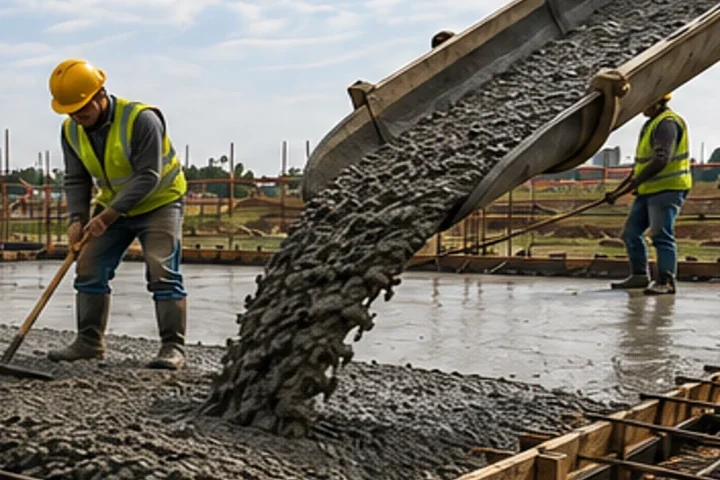
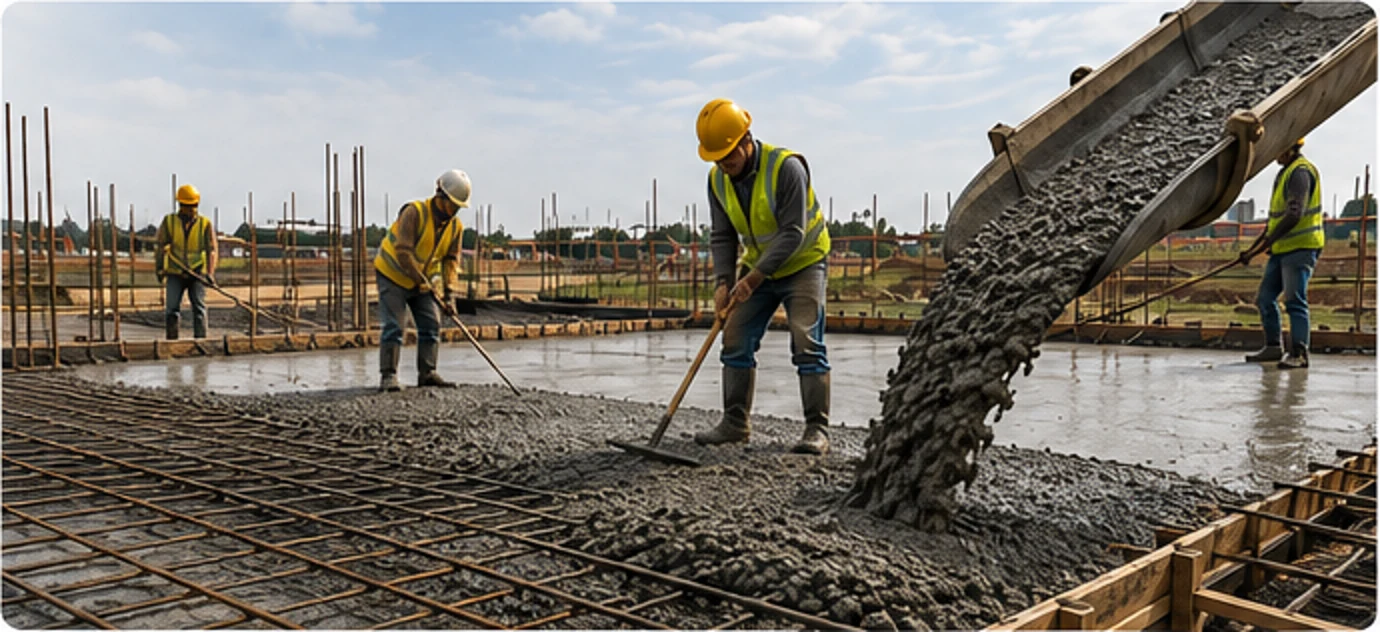 Concrete placement over a reinforced slab system
Quick Answer
For a rectangular slab, multiply the slab’s length × width × thickness after converting all measurements to compatible units.
For a slab measuring 6 m × 4 m × 150 mm, first convert 150 mm to 0.15 m:
Important: this is a quantity calculation. It does not determine structural slab thickness, reinforcement, concrete strength or design.
1. What You Need Before Calculating
Concrete is estimated by volume. For metric projects, the result is normally expressed in cubic meters (m³). You need three dimensions: length, width and thickness.
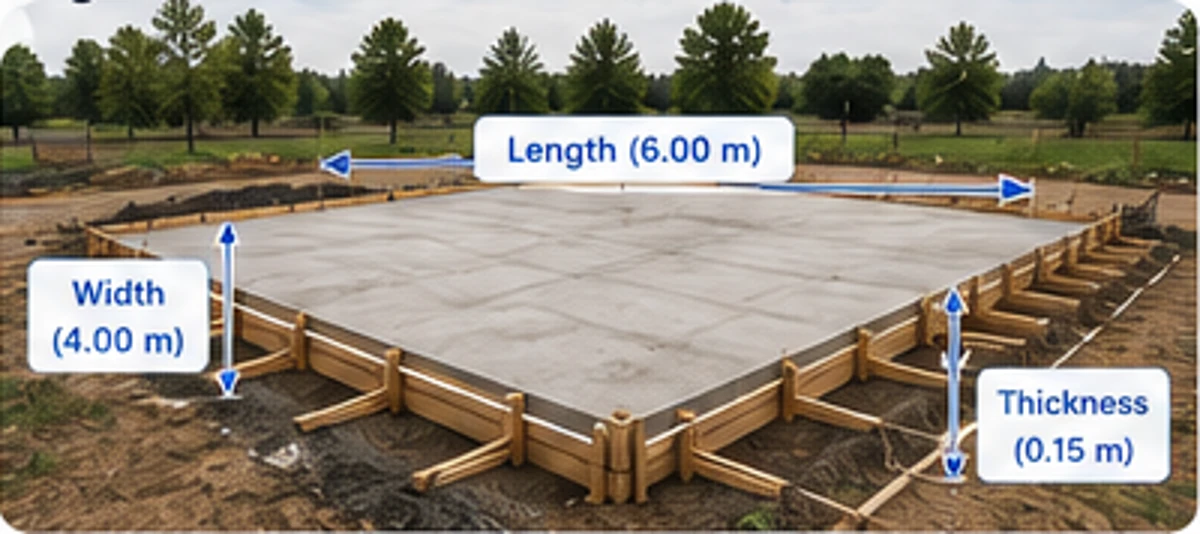
The three measurements that control the geometric volume of a rectangular slab.
| Dimension | Example | Use in formula |
|---|---|---|
| Length | 6.00 m | 6.00 |
| Width | 4.00 m | 4.00 |
| Thickness | 150 mm | 0.15 m |
2. Concrete Slab Volume Formula
A rectangular slab is a three-dimensional shape, so its volume follows the standard geometric formula:
Want to skip the manual conversion? Enter your slab dimensions directly.
3. Step-by-Step Example
Suppose you are planning a slab measuring 8 m × 5 m × 120 mm.
4. Converting Slab Thickness Correctly
One of the easiest mistakes is mixing meters and millimeters. When length and width are in meters, convert thickness to meters before multiplying. NIST’s measurement tables define one millimeter as exactly 0.001 meter.
5. Should You Add Extra Concrete?
The formula gives the ideal geometric volume. The quantity ordered on a real project can differ because of uneven subgrade, excavation variation, formwork tolerances, thickened areas, placement losses or differences between drawings and field measurements.
No added allowance
4.80 × 1.05
4.80 × 1.10
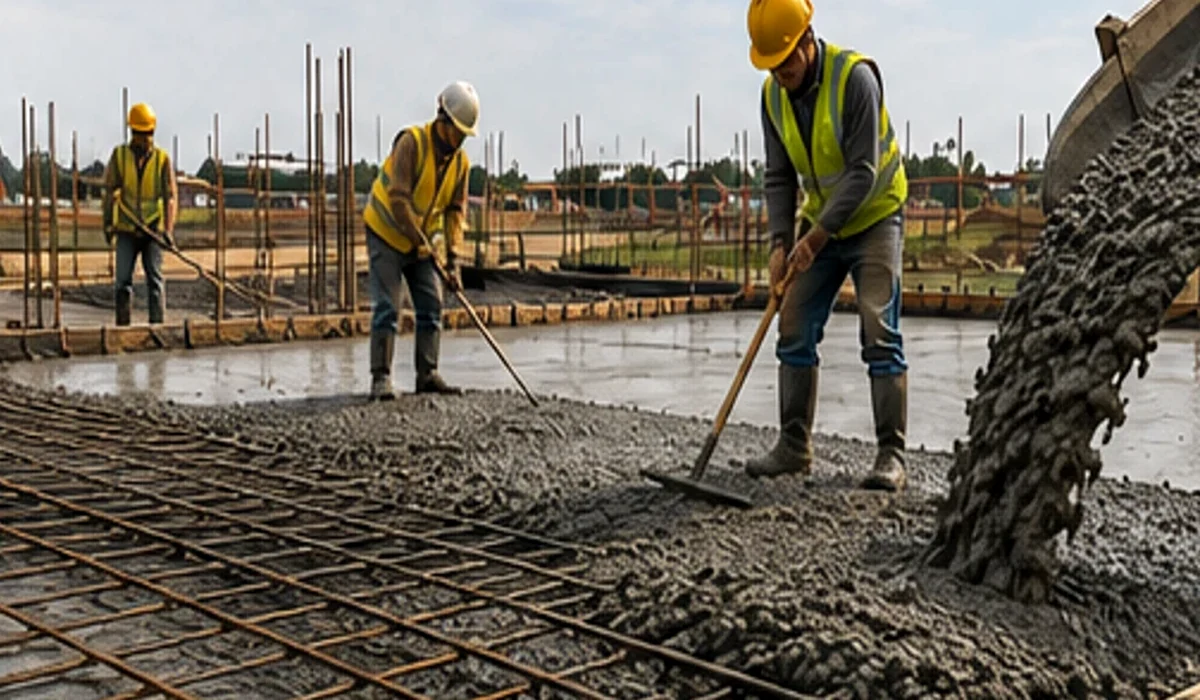
Why field conditions matter
Drawings provide the intended geometry, but the final quantity can be affected by actual excavation levels, edge details, formwork and local variations in slab depth.
For the final order, compare your calculation with the project documents and what is actually built on site.
6. Calculating an Irregular or L-Shaped Slab
For an irregular footprint, divide the slab into simple shapes, calculate each volume separately, then add the results.
Section A: 6 × 4 × 0.15 = 3.60 m³
Section B: 3 × 2 × 0.15 = 0.90 m³
If sections have different thicknesses, calculate each thickness separately.
7. Common Concrete Calculation Mistakes
Convert millimeters, centimeters and meters before multiplying.
Square meters alone cannot determine a concrete quantity.
Beams, pads, drops and thickened edges may require separate quantities.
Significant voids may need to be deducted when appropriate.
A volume calculator does not determine structural adequacy.
Verify the actual site and supplier requirements before the final order.
8. Quick Concrete Volume Examples
| Slab | Calculation | Theoretical volume |
|---|---|---|
| 5 m × 4 m × 100 mm | 5 × 4 × 0.10 | 2.00 m³ |
| 10 m × 6 m × 150 mm | 10 × 6 × 0.15 | 9.00 m³ |
| 100 m² × 120 mm | 100 × 0.12 | 12.00 m³ |
Calculate Your Concrete in Seconds
Enter your slab dimensions in Architect Tools for a quick preliminary volume estimate, then verify the final project quantity against drawings and actual site conditions.
9. Before Ordering Concrete
Before placing a final order, check project documents and actual site conditions. Verify slab dimensions, specified thickness, thickened edges, beams, footings, openings, level changes, tolerances and supplier requirements.
Quantity is only one part of slab construction
ACI 302.1R-15 addresses concrete floor and slab construction topics including site preparation, concrete materials, joints, workmanship, finishing and curing.
Use the calculator for preliminary quantity planning, not as a replacement for structural or construction documentation.
10. Frequently Asked Questions
How do you calculate concrete volume?
For a rectangular element, multiply length × width × thickness using compatible units. When all dimensions are in meters, the result is in cubic meters.
How much concrete do I need for a 100 m² slab?
It depends on thickness. At 100 mm, the theoretical volume is 10 m³. At 150 mm, it is 15 m³.
How much concrete is needed for a 6 × 4 m slab?
You also need thickness. At 150 mm: 6 × 4 × 0.15 = 3.60 m³. You can enter these dimensions directly in the Concrete Calculator.
Is 100 mm enough for a concrete slab?
A volume calculator cannot determine structural adequacy. Required thickness depends on purpose, loads, support, reinforcement, materials, applicable requirements and professional design.
Does concrete volume include reinforcement?
No. Concrete volume and reinforcement quantity are separate calculations.
Key Takeaways
- For a rectangular slab, use Length × Width × Thickness.
- Convert slab thickness to the same unit system before multiplying.
- Irregular slabs are easier to calculate when divided into simple sections.
- Do not assume a universal waste allowance; verify actual project conditions.
- Use the Concrete Calculator for fast preliminary estimates.
11. Sources & Technical References
ACI 302.1R-15 provides technical guidance for concrete floor and slab construction, including materials, site preparation, joints, workmanship, finishing and curing.
Institutional guidance on cement and concrete applications, including ready-mixed concrete, placement and curing.
Handbook 44 Appendix C provides general tables of units of measurement, including exact metric unit relationships.
Calculate your slab
Enter length, width and thickness for an instant preliminary volume estimate.
Useful Resources
Concrete CalculatorCalculate slab volume directly→
All CalculatorsBrowse the complete tool library→
Construction GuidesExplore more practical articles→
Formula examples are checked before publication. Technical context is supported by primary or institutional sources where appropriate.