
How Much Concrete Do I Need?
A practical guide to estimating concrete for slabs, footings, walls and round columns—with worked examples, unit checks and a safer ordering workflow.
 Measure first, calculate volume, then verify the final order
Quick Answer
To estimate how much concrete you need, calculate the volume of each concrete element and add the results. For a rectangular element:
For an 8 m × 5 m slab that is 120 mm thick, convert 120 mm to 0.12 m:
Important: 4.80 m³ is the theoretical geometric volume. The final quantity ordered should be checked against drawings, actual site conditions and supplier requirements.
1. Start With Volume, Not Area
Concrete quantity is a three-dimensional measurement. A floor area in square meters does not tell you how much concrete is needed until you also know the concrete depth or thickness.
The SI unit of volume is the cubic meter (m³). NIST also notes that 1 m³ = 1,000 liters, which is useful when comparing smaller liquid or material volumes.
2. Concrete Volume Formulas by Shape
Most projects can be broken into a few simple geometric shapes. Calculate each shape separately, then add the volumes.
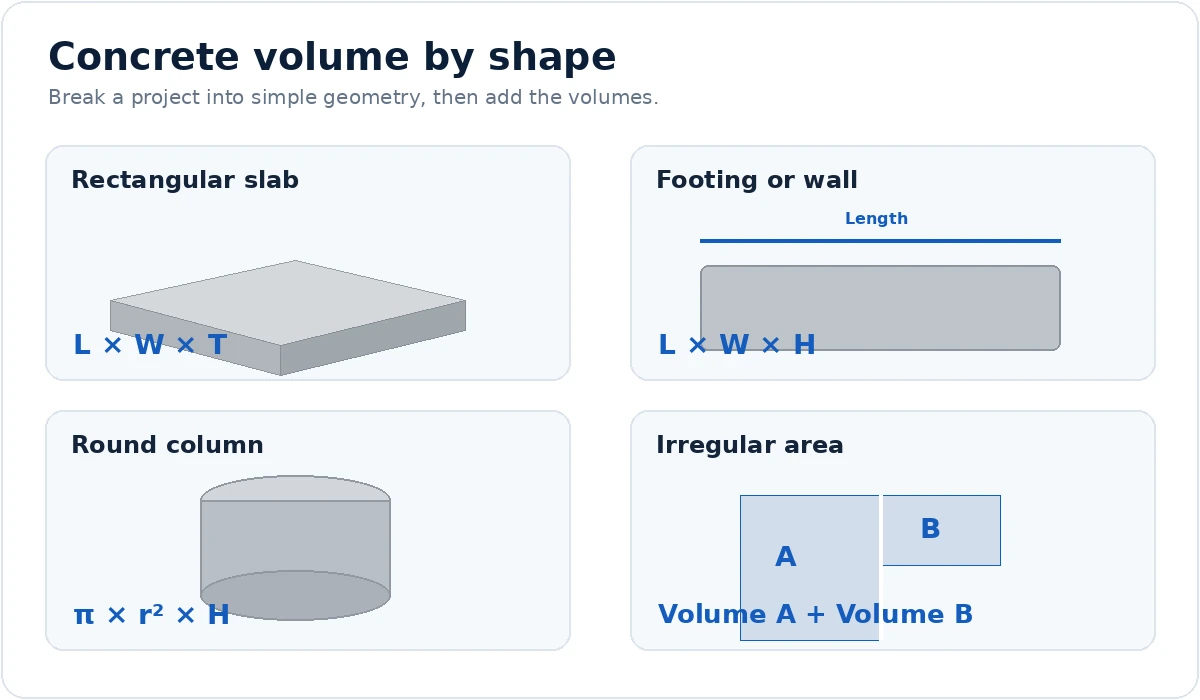
Four common ways to break a concrete project into measurable volumes.
| Element | Formula | Typical inputs |
|---|---|---|
| Rectangular slab | L × W × T | Length, width, thickness |
| Wall / strip footing | L × W × H | Length, width, height/depth |
| Round column / pier | π × r² × H | Radius, height |
| Irregular layout | Volume A + B + C… | Separate simple sections |
If your project is a rectangular slab or similar element, enter the dimensions directly instead of repeating the arithmetic.
3. Example: How Much Concrete for a Slab?
Suppose a slab measures 8 m long × 5 m wide × 120 mm thick.
4. Example: Strip Footing or Foundation
A strip footing can usually be treated as a long rectangular prism. If a footing is 12 m long × 0.50 m wide × 0.25 m deep:
If the foundation has several independent strips, calculate each strip separately and add the results. This is especially useful when footing widths or depths change around the building.
5. Example: Round Columns and Concrete Piers
A circular column uses the volume formula for a cylinder:
For a column with a 400 mm diameter and a 3 m height, the radius is 0.20 m:
For six identical columns:
6. Example: Concrete Wall
For a simple rectangular wall measuring 10 m long × 2.8 m high × 200 mm thick:
Large door or window openings may need to be deducted where appropriate. Complex wall geometry, pilasters, thickened zones or changes in section should be measured separately.
7. Irregular Projects: Divide, Calculate, Add
Trying to force an irregular footprint into one large rectangle can overestimate concrete significantly. Divide the project into simple sections instead.
Section A: calculate its own length × width × thickness.
Section B: calculate separately.
Apply the same approach to steps, pads, ramps, beams and other distinct shapes.
8. From Calculated Volume to the Final Concrete Order
The geometry is only the first part of the process. NRMCA’s CIP 31 — Ordering Ready Mixed Concrete explains that there is no single typical concrete recipe and that the purchaser should provide project-specific requirements. The concrete producer can help select a suitable mixture based on the application and specified performance.
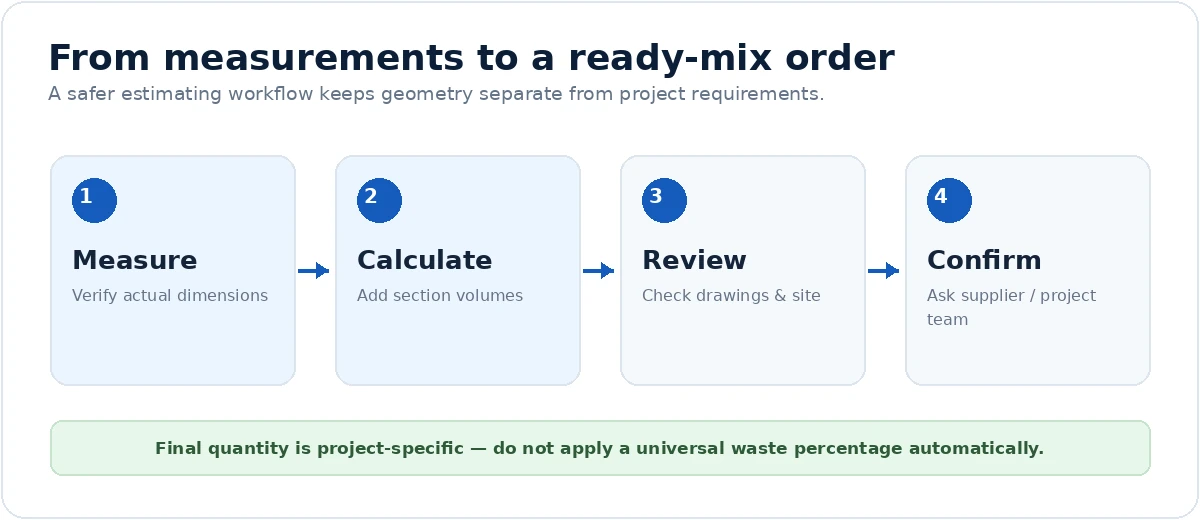
Keep the geometric quantity calculation separate from mixture selection and final order confirmation.
Before ordering, review the calculated quantity against:
Confirm what has been formed or excavated on site.
Check thickness changes, beams, pads and edge details.
Exclude significant voids when appropriate.
Uneven subgrade and dimensional variation can affect volume.
Confirm minimum order, increments and delivery constraints.
Quantity alone does not specify strength, exposure class or mixture.

Quantity and concrete specification are different decisions
Your volume calculation estimates how much concrete the geometry contains. It does not define the concrete mixture, structural strength, slump, air content, reinforcement or curing method.
ACI and NRMCA guidance should be used together with the project documents and qualified professional requirements.
9. Should You Add a Waste or Site Allowance?
There is no universal percentage that is correct for every project. The theoretical volume can differ from the final order because of excavation variation, formwork tolerances, uneven subgrade, overbreak, small placement losses and other field conditions.
Geometry only
Example, not a universal rule
Example, not a universal rule
10. Metric and U.S. Volume Units
Metric projects commonly use cubic meters. U.S. projects often order ready-mixed concrete in cubic yards. NIST lists the exact conversion factor:
| Unit | Equivalent |
|---|---|
| 1 cubic meter (m³) | 1,000 liters |
| 1 cubic yard (yd³) | 0.7645549 m³ |
| 1 m³ | ≈ 1.308 yd³ |
Do not mix feet, inches, meters and millimeters inside the same formula without converting them first.
11. Common Concrete Quantity Mistakes
Area alone is not concrete volume.
Convert mm, cm, m, ft and in before multiplying.
For a cylinder, radius = diameter ÷ 2.
Footings, beams, pads and steps may need individual calculations.
Allowances should reflect actual site conditions.
A volume estimate does not determine structural adequacy.
Estimate Your Concrete Volume
Use the Architect Tools Concrete Calculator for a fast preliminary quantity estimate, then verify the final order against project documents and site measurements.
12. Frequently Asked Questions
How much concrete do I need for a 10 × 10 m slab?
You also need the thickness. At 100 mm (0.10 m), the theoretical volume is 10 × 10 × 0.10 = 10 m³. At 150 mm, it is 15 m³.
How do I calculate concrete for a footing?
For a rectangular footing, multiply length × width × depth. Calculate different footing sizes separately and add the volumes.
How do I calculate concrete for a round column?
Use π × radius² × height. Make sure you use radius, which is half the diameter.
Should I order exactly the calculated concrete volume?
The calculated value is the theoretical geometric volume. The final order should account for actual project conditions and supplier requirements rather than relying on a universal percentage.
Does the concrete calculator tell me what concrete strength to use?
No. A quantity calculator estimates volume. Concrete strength, mixture requirements, exposure conditions and structural design come from the project specifications and appropriate professional guidance.
Can I calculate concrete in cubic yards?
Yes. NIST lists 1 cubic yard as 0.7645549 cubic meter. Use one unit system consistently throughout the calculation.
Key Takeaways
- Concrete quantity starts with volume, not area.
- Break complex projects into simple shapes and add the volumes.
- Keep units consistent before multiplying dimensions.
- Theoretical volume and final ready-mix order are not always identical.
- Use project documents, site measurements and supplier guidance for the final order.
- Use the Concrete Calculator for quick preliminary estimates.
13. Sources & Technical References
CIP 31 covers ordering ready-mixed concrete and emphasizes project-specific concrete requirements and coordination with the producer.
NIST references define SI volume units and conversion factors, including cubic meters, liters and cubic yards.
ACI 302.1R-15 provides guidance on floor and slab construction, including mixture proportions, site preparation, placing, finishing and curing.
Institutional guidance on ready-mixed concrete, concrete materials, placement, consolidation and curing.
Estimate concrete volume
Enter dimensions for a quick preliminary quantity estimate.
Useful Resources
Concrete CalculatorEstimate concrete volume directly→
Slab Volume GuideStep-by-step slab calculation→
All CalculatorsBrowse the complete tool library→
Worked examples are checked before publication. Technical context is supported by primary or institutional sources where appropriate.