Getting an accurate measurement is the single most important part of any concrete job, and that starts when you figure concrete for slab volume before ordering a single truck of ready-mix. Guess wrong and you either pay for wasted material or stop the pour halfway through a driveway or patio. This guide breaks down the exact formulas, conversion tables, and cost math that professional estimators rely on daily. You’ll also learn how to pour a concrete slab correctly once your numbers are locked in and ready for the crew.
[rank_math_toc]

How to Figure Concrete for Slab: The Basic Volume Formula
To figure concrete for slab volume correctly, you only need three measurements: length, width, and thickness. Multiply the length by the width to find the square footage of your slab area.
Next, multiply that square footage by the thickness in feet to get the total cubic feet of concrete needed. Divide the result by 27 to convert cubic feet into cubic yards, since ready-mix concrete is always sold by the yard.
For example, a 20 ft by 20 ft slab poured 4 inches thick equals 400 square feet times 0.33 feet, or about 133 cubic feet. Divide by 27 and you need roughly 4.93 cubic yards, a number any concrete slab calculator would confirm instantly.

Step-by-Step Process to Figure Concrete for Slab Quantities
Follow this five-step checklist every time you figure concrete for slab quantities on a new job. Skipping any step is where most volume errors creep into an estimate.
- Measure length and width in feet at multiple points.
- Confirm slab thickness — typically 4 inches for patios, 6 inches for driveways.
- Calculate the total area in square feet.
- Convert cubic feet to cubic yards using the 27 divisor.
- Add a 5–10% waste factor for spillage and subgrade irregularities.
Always verify your dimensions with our volume calculator before you call the ready-mix plant to place an order.
Concrete Slab Calculator Formulas & Conversion Table
A dependable concrete slab calculator automatically converts thickness in inches into cubic yards. Before trusting any digital tool, it helps to figure concrete for slab volume manually once, just to confirm the output makes sense.

| Thickness | Cubic Feet / 100 sq ft | Cubic Yards / 100 sq ft | Typical Use |
|---|---|---|---|
| 4 in | 33.3 | 1.23 | Patios, sidewalks |
| 5 in | 41.7 | 1.54 | Garage floors |
| 6 in | 50.0 | 1.85 | Driveways |
| 8 in | 66.7 | 2.47 | Heavy equipment pads |
Whether you’re pouring a small cement pad for an HVAC unit or a full concrete pad for a workshop floor, this chart removes the guesswork from ordering. Use our free online concrete calculator to plug in your exact custom dimensions instantly.
This conversion table works for any project size, but you should still figure concrete for slab overages before finalizing your truck order with the plant dispatcher.
Concrete Slab Cost Calculator: Estimating Your Total Budget
Once you figure concrete for slab volume, the next step is pricing the entire job accurately. Ready-mix concrete typically runs $125 to $165 per cubic yard delivered, depending on region and mix strength.
A concrete slab cost calculator also factors in labor, wire mesh reinforcement, form lumber, and finishing crews. Most homeowners pay between $6 and $12 per square foot installed for a standard 4-inch slab.
Larger concrete slabs benefit from bulk pricing, while smaller concrete pad calculator jobs under a yard often pay a short-load fee. Always ask your supplier about minimum order charges before scheduling delivery.
A concrete slab cost calculator makes budgeting simple, but seasoned estimators still figure concrete for slab totals by hand once to confirm accuracy before signing a contract.
| Slab Size | Cubic Yards Needed | Material Cost (Est.) | Total Installed Cost |
|---|---|---|---|
| 10 x 10 ft | 1.2 yd³ | $180 | $700 – $1,200 |
| 20 x 20 ft | 4.9 yd³ | $735 | $2,800 – $4,800 |
| 24 x 24 ft | 7.1 yd³ | $1,065 | $4,000 – $6,900 |
How to Pour a Concrete Slab: Site Prep to Finishing
Knowing how to pour a concrete slab properly protects the investment you just calculated. Start by excavating 6 to 8 inches below grade and compacting a gravel base to prevent future settling.
Set your forms level and square, then place rebar or wire mesh at the mid-depth of the slab. Before the truck arrives, figure concrete for slab volume one final time against the actual excavated dimensions.
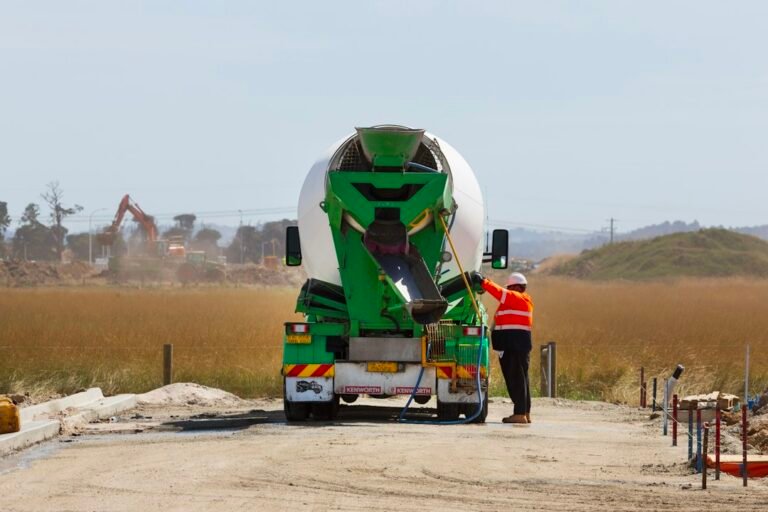
Order slightly more than your calculated total, since concrete on slab jobs rarely use the exact estimated amount once forms settle. Pour continuously when possible and screed the surface flat with a straightedge.
Float and trowel the surface once bleed water disappears, then cut control joints at proper intervals. Cure the finished cement pad under plastic sheeting or a curing compound for at least seven days.
Material Calculator for Concrete Slab: Bagged Mix vs Ready-Mix
A material calculator for concrete slab projects also compares bagged concrete against bulk delivery options. Bagged mixes work fine for small jobs, but you still need to figure concrete for slab totals precisely to avoid running short mid-pour.
An 80-lb bag yields roughly 0.6 cubic feet of concrete once mixed. For a 4×4 ft cement pad poured 4 inches thick, you’d need close to 90 bags, which quickly becomes more expensive than ordering a quarter-yard ready-mix load.
Concrete slabs larger than one cubic yard should always use delivered ready-mix for consistency and strength control. According to engineering references on concrete mix design, proper curing and water-cement ratios significantly affect long-term slab durability.
Common Mistakes When You Figure Concrete for Slab
The most frequent error is forgetting to figure concrete for slab thickness variations across a sloped or uneven subgrade. Always take multiple depth readings across the pour area, not just one corner measurement.
Another common mistake is skipping the waste factor entirely. Experienced crews building a concrete slab estimator spreadsheet always add a 5-10% buffer, since running short mid-pour creates a weak cold joint.
Finally, some crews order concrete on slab jobs without checking the ready-mix plant’s minimum yardage requirement, triggering costly short-load surcharges. Estimating concrete slab needs correctly the first time avoids frustrating return trips and delays.
Frequently Asked Questions
How do I figure concrete for slab for an irregular shaped area?
Break the shape into smaller rectangles and triangles, calculate each section’s volume separately, then add the totals together. This is the same method any concrete slab calculator uses internally, so you always figure concrete for slab volume the same way regardless of shape.
How much extra concrete should I order for waste?
Add 5% to 10% on top of your calculated cubic yards to cover spillage, form leakage, and subgrade irregularities. This buffer is standard practice for any concrete slab estimator worksheet.
Can I pour a concrete pad without rebar?
Small pads under 4 inches thick that carry no structural load, like a shed pad, can sometimes skip rebar. Driveways and garage cement pad slabs almost always need reinforcement mesh or rebar.
What thickness should I use for a driveway concrete slab?
Use 5 to 6 inches for standard passenger vehicles and 6 to 8 inches if heavy trucks or RVs will park regularly. Thicker slabs reduce cracking risk under repeated heavy loads.
Mastering how to figure concrete for slab volume, cost, and pour sequencing turns a stressful project into a predictable one. Whether you use a digital concrete slab calculator or manual math, you now know exactly how to figure concrete for slab needs, control costs, and pour with confidence.