Ready-mix concrete is commonly ordered by cubic yard in the United States. A cubic yard is a cube measuring 3 ft on each side, so 1 yd³ = 3 × 3 × 3 = 27 ft³. This guide explains cubic feet to cubic yards for a measured pour, keeping area, thickness and volume separate.
Convert cubic feet to cubic yards by dividing by 27, then use the worked examples and seven checks below to verify your concrete estimate.
Convert cubic feet to cubic yards in one step
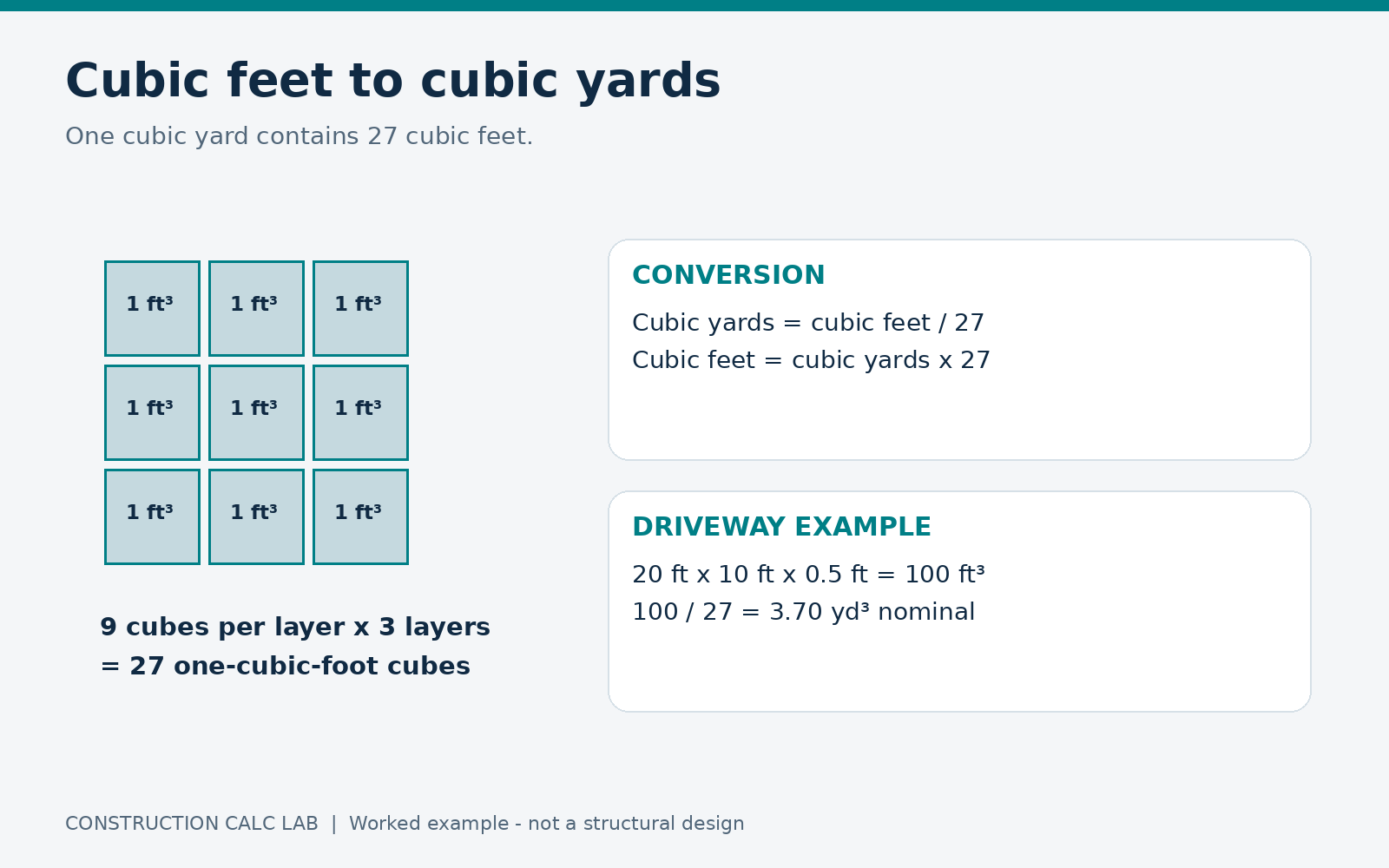
Cubic yards = cubic feet ÷ 27. To go back, multiply cubic yards by 27. If the starting dimensions include inches, first convert those dimensions to feet: thickness in feet = thickness in inches ÷ 12.
| Volume in cubic feet | Volume in cubic yards |
|---|---|
| 27 ft³ | 1 yd³ |
| 54 ft³ | 2 yd³ |
| 81 ft³ | 3 yd³ |
| 100 ft³ | 3.70 yd³ |
Example: a 10 × 10 ft slab at 4 in
Area = 10 × 10 = 100 ft². Thickness = 4 ÷ 12 = one-third of a foot. Volume = 100 × 1/3 = 33.33 ft³. Convert: 33.33 ÷ 27 = 1.23 yd³ nominal. Retain extra digits through the calculation, then decide on an allowance and round according to the supplier’s ordering increments.
Example: a 20 × 10 ft driveway at 6 in
Thickness = 6 ÷ 12 = 0.5 ft. Volume = 20 × 10 × 0.5 = 100 ft³, or 3.70 yd³. With an illustrative 5% site allowance, the planning quantity becomes 3.70 × 1.05 = 3.89 yd³. Confirm the actual order with the ready-mix plant; a blanket allowance can be too high or too low for the site.
For multiple pours and metric measurements
Calculate each non-overlapping section separately in cubic feet, add them, then divide the total by 27. If you work in metres, multiply length × width × depth to get cubic metres. 1 m³ ≈ 1.308 yd³; 1 yd³ ≈ 0.765 m³. Keep the supplier’s unit explicit on your order.
Common errors when converting cubic feet to cubic yards
- Square feet are area: multiply by thickness to obtain cubic feet.
- Do not treat inches as feet: a 4 in slab is 1/3 ft thick, not 4 ft.
- Measure inside forms: the ground or form width may differ from the drawing.
- Separate price from volume: material, short-load, delivery and pump charges vary by place and supplier. Request a written local quote.
Use the Construction Calc Lab calculator as a cross-check before ordering. The engineer’s drawings determine the required thickness and mix specification.
Why cubic feet to cubic yards uses 27
A yard is three feet long, but a cubic yard extends in three directions. That is why converting cubic feet to cubic yards uses 3 × 3 × 3 rather than simply 3. Imagine a box that is three feet wide, three feet long and three feet high. It contains three layers, each with nine one-foot cubes. Altogether, the box contains 27 cubic feet.
This explanation also helps distinguish length, area and volume. Divide feet by 3 to convert a length to yards. Divide square feet by 9 to convert an area to square yards. Divide cubic feet by 27 to convert a volume to cubic yards. These operations are related, but they are not interchangeable. A material order for concrete needs the volume conversion.
7 easy checks for cubic feet to cubic yards calculations
1. Identify the shape
Before converting cubic feet to cubic yards, identify whether the pour is a rectangular slab, strip footing, circular pier or a combination of shapes. A rectangular formula will not correctly describe a round post hole. Sketch the geometry and mark the measurements needed for each section. Name the sections so that you can trace each subtotal back to a particular part of the plan.
2. Convert each dimension to feet
A measurement of 8 ft 6 in becomes 8 + (6 ÷ 12) = 8.5 ft. It does not become 8.6 ft. Similarly, 7 ft 3 in becomes 7.25 ft. For cubic feet to cubic yards calculations with mixed measurements, convert each dimension before multiplication. Small dimension errors can accumulate across a long driveway or a repeated series of footings.
3. Keep thickness separate from area
Multiply length by width to obtain square feet, then multiply by the thickness in feet. This two-stage method is easier to review than an unlabeled string of numbers. Label the area and volume columns differently. If your worksheet shows a square-foot result in a cubic-foot column, the missing thickness is immediately visible.
4. Add compatible subtotals
Only add quantities expressed in the same unit. If one contractor provides cubic metres and another provides cubic feet, convert one before adding them. Likewise, never add a bag count directly to a ready-mix volume. First convert the bags to their stated mixed yield, then combine the volume if both materials are genuinely part of the same estimate.
5. Divide the completed cubic-foot total by 27
Perform the cubic feet to cubic yards conversion after the geometry is complete. Keep several decimal places in intermediate calculations. You can display the final result to two decimals for readability, but retain the unrounded value when calculating allowances. Repeatedly rounding small individual quantities can noticeably change a large combined estimate.
6. Add a justified allowance
A material allowance is separate from the cubic feet to cubic yards conversion. It covers uncertainty in the actual fill volume and placement, not an error in unit conversion. If your measured trench is larger than its drawing, correct the dimensions first. Then discuss any additional allowance with the contractor and supplier using the actual site conditions.
7. Confirm the order increment
Ask the plant what quantities it can supply and how small loads are charged. Do not assume that every supplier rounds to the same quarter-yard or half-yard increment. Write down the exact quantity ordered so it can be compared with the delivered tickets. Keep the nominal requirement beside it for a clear audit trail.
Cubic feet to cubic yards: a patio and walkway example
Suppose a rectangular patio measures 16 × 12 ft and a separate connecting walkway measures 18 × 3 ft. Both have a specified thickness of 4 in. Assume the dimensions describe two areas that meet at an edge and do not overlap. The patio area is 192 ft² and the walkway area is 54 ft², giving a combined area of 246 ft².
Convert thickness: 4 ÷ 12 = one-third of a foot. Multiply the combined area by this thickness: 246 ÷ 3 = 82 ft³. Now convert cubic feet to cubic yards: 82 ÷ 27 = 3.037 yd³. An illustrative 5% allowance gives 3.189 yd³ before supplier rounding. If the supplier accepts quarter-yard orders, 3.25 yd³ would cover that calculated requirement.
The example changes if the walkway sits inside the patio dimensions. In that case, counting its entire area again would double-count concrete. The drawing must show whether measured rectangles overlap. Resolve overlaps before converting cubic feet to cubic yards; no calculator can identify them without the correct inputs.
| Section | Area | Thickness | Volume |
|---|---|---|---|
| Patio | 192 ft² | 4 in | 64 ft³ |
| Walkway | 54 ft² | 4 in | 18 ft³ |
| Total before allowance | 246 ft² | 4 in | 82 ft³ / 3.037 yd³ |

Reverse the calculation: coverage from cubic yards
Sometimes you know how much concrete is available and want to know the area it can cover. Convert the available cubic yards into cubic feet by multiplying by 27. Divide that volume by thickness in feet. The result is square feet of theoretical coverage, before allowing for site variation or material left in the placement equipment.
One cubic yard contains 27 ft³. At 4 in thick, theoretical coverage is 27 ÷ (4/12) = 81 ft². At 6 in thick, it is 27 ÷ 0.5 = 54 ft². At 8 in thick, it is 27 ÷ (8/12) = 40.5 ft². These figures are useful checks, but they do not determine the structurally appropriate thickness.
If someone claims that a fixed volume covers the same area at every thickness, the calculation is incomplete. Coverage falls as thickness rises. Doubling thickness halves theoretical coverage for the same volume. This simple relationship is a useful way to catch an unrealistic estimate before requesting a detailed quote.
Cubic yards describe volume, not weight
There is no single exact conversion from cubic yards to tons for every concrete mixture. Weight depends on density, and different materials have different densities. Lightweight concrete, normal-weight concrete and demolition rubble should not be treated as interchangeable. A supplier’s density information is the appropriate starting point when weight matters.
For a clearly labeled arithmetic example, assume a material density of 150 lb/ft³. One cubic yard would weigh 27 × 150 = 4,050 lb. Dividing by 2,000 gives 2.025 US short tons. This example does not establish a load rating or transport allowance. Vehicle loading and access decisions need the actual material and equipment information.
The words ton and tonne also refer to different mass units. A US short ton is 2,000 lb; a metric tonne is 1,000 kg. Always spell out which unit is used in a quotation or weight worksheet. For further context, see our guide to concrete density and weight.
Use the converted quantity in a cost estimate
Once you have a planning quantity, multiply it by a supplier’s quoted rate per cubic yard. If a supplier hypothetically quotes $160/yd³ and the order is 3.25 yd³, the material line is 3.25 × $160 = $520. The rate here is an example only, not a market price. Add the charges stated on the actual quote.
Keep delivery, minimum-load charges, waiting time, pumping, taxes and labor in separate rows. An apparently cheaper price per yard can produce a more expensive overall order if fixed charges are higher. Compare quotations at the same quantity, mix specification and delivery conditions. The conversion worksheet supports that comparison but does not replace a complete quotation.
Cubic feet to cubic yards with feet-and-inches measurements
Suppose a small slab is 8 ft 6 in long, 7 ft 3 in wide and 5 in thick. Convert the inputs to 8.5 ft, 7.25 ft and 5/12 ft. The area is 61.625 ft². Multiplying by 5/12 gives 25.677 ft³. Dividing by 27 gives approximately 0.951 yd³ before any allowance.
Entering 8.6 instead of 8.5 and 7.3 instead of 7.25 might not create an obviously absurd result. It would still look like a small concrete order. This is why a plausibility check alone is insufficient: you should also verify the conversion of each mixed measurement. A separate input column for feet and inches can make a reusable worksheet less error-prone.
In a spreadsheet, the dimension formula is feet plus inches divided by twelve. Keep the input cells separate from the calculated cells, and label them clearly. If someone types a total decimal-foot value into the inches column, the worksheet should be reviewed before it is used. The mathematical formula cannot determine what the person intended to enter.
Check cubic feet to cubic yards without repeating every step
Reversing a cubic feet to cubic yards calculation can reveal a misplaced decimal. Multiply the proposed cubic-yard result by 27, then divide by the measured plan area. The answer should equal the thickness in feet. Multiply by 12 to compare it with the intended thickness in inches. This checks the relationship between the three principal quantities.
For example, an estimate of 3.70 yd³ for a 200 ft² driveway gives approximately 99.9 ft³. Dividing by 200 gives 0.4995 ft, or about 6 in. That agrees with the six-inch example. If the reverse calculation produced about 60 in instead, a tenfold error would be visible immediately.
The reverse check only tests mathematical consistency. It cannot prove that the dimensions are correct or that the specified thickness is appropriate. Use it alongside measurement review, not as a replacement. The strongest estimate has both a clear geometric basis and arithmetic that can be checked independently.
A reusable conversion worksheet
Use a row for each non-overlapping section and columns for its reference, length, width, thickness, cubic feet and cubic yards. Add a notes column for unusual geometry or field measurements. At the bottom, show the subtotal, allowance, rounded order and supplier quotation. The layout should let another person reproduce the result without asking how a number was obtained.
Keep prices separate from the cubic feet to cubic yards calculation. That lets you change the supplier’s price without changing the measured volume. It also prevents delivery fees from being hidden inside a supposed material rate. If you later compare bids, the same verified quantity can be applied to each supplier’s clearly stated pricing structure.
When a dimension changes, update its original input instead of overwriting the total. Record the revision date and briefly explain the change. This preserves the calculation path and helps identify whether the new order includes all required sections. A clear cubic feet to cubic yards worksheet should remain understandable even after several revisions.
Cubic feet to cubic yards: practical questions
Why should I not round 4 inches to 0.3 feet?
Four inches equals approximately 0.3333 ft. Using 0.3 ft understates thickness by 10%, which understates volume by the same proportion when area stays constant. Use 4/12 in the formula or retain enough decimal places. Rounding a displayed result is different from rounding an input before calculation.
Can I enter square feet directly into the conversion?
No. You must multiply area by thickness first. Dividing square feet by 27 produces a number with no useful interpretation as the concrete volume required. If a calculator accepts area, it should also ask for thickness. Review the slab calculation guide for the complete sequence.
Does fresh concrete use the same volume unit as cured concrete?
A cubic foot and a cubic yard are fixed units regardless of the material’s condition. For ordering, however, the supplier’s basis is the delivered fresh concrete volume. Use the ordered volume and the project’s geometry rather than trying to estimate an order from the apparent dimensions of loose ingredients.
What if the supplier quotes in cubic metres?
Confirm the unit before accepting the quote. Convert the completed volume rather than interpreting one cubic yard as one cubic metre. For example, 3 yd³ is approximately 2.294 m³. The numerical difference is large enough to matter on a small order, so include the unit in email confirmations, quotations and delivery instructions.
Can all dimensions be entered in inches?
Yes, if the worksheet consistently uses cubic inches and then converts the completed volume. Multiply length, width and thickness in inches, divide by 1,728 to get cubic feet, and then divide by 27 to get cubic yards. Equivalently, divide cubic inches by 46,656. Do not use this shortcut when some dimensions are still in feet. Label the input unit prominently so another person does not mistake an inches-only worksheet for a mixed-unit calculator.
What should I send to the supplier?
Send the final volume in the agreed unit, the specified mix, the delivery location, planned time and placement method. The NRMCA ordering guide provides an industry reference for that conversation. Keep the dimensions and cubic feet to cubic yards calculation in your own records so any last-minute change can be checked quickly.
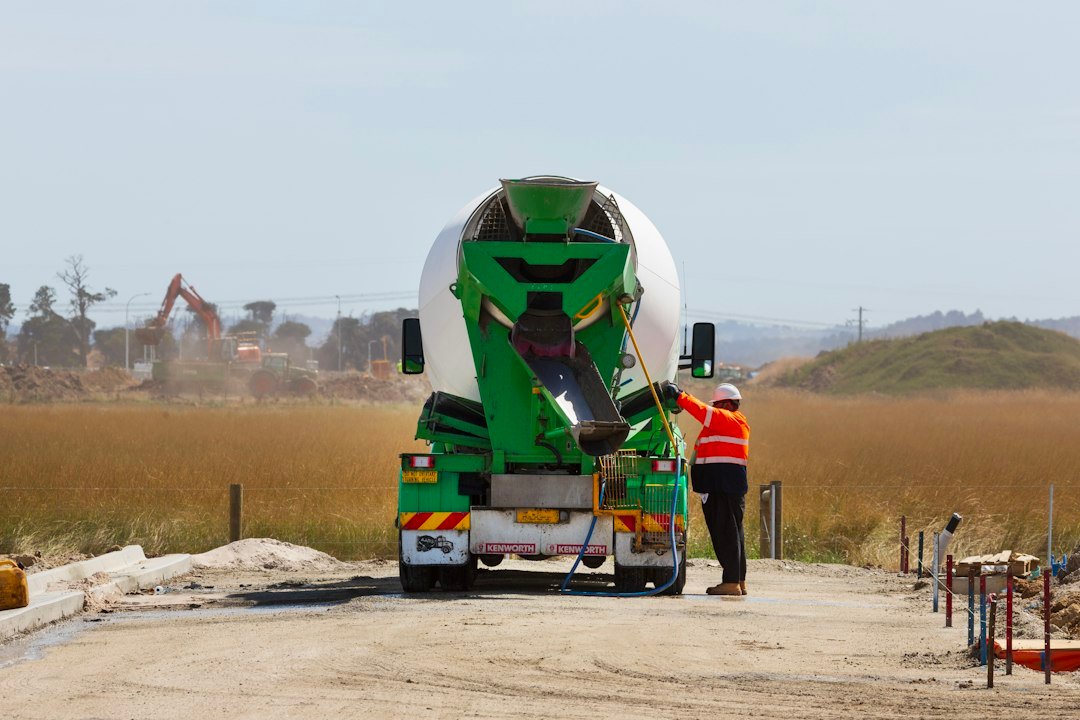
Featured photo: Troy Mortier / Unsplash.