How many concrete bags for a slab? Start with the finished dimensions, calculate the concrete volume in cubic feet, then divide by the wet yield printed on your chosen bag. For a level 10 ft × 10 ft slab that is 4 in thick, the theoretical volume is 33.33 cubic feet. That is about 56 bags of 80 lb mix or 75 bags of 60 lb mix using the common yields of 0.60 and 0.45 cubic feet per bag. Add a site-specific allowance before buying; a 10% planning allowance changes those counts to 62 and 82 bags respectively.
This guide shows the arithmetic, explains where bag estimates go wrong, and gives you a practical way to decide whether to mix bags or request a ready-mix quote. The quantities are estimates for a rectangular slab with uniform depth. Measure the actual forms and check the product label before you purchase.
Concrete bags for a slab: the quick formula
Use one unit of length throughout the calculation. If you measure the plan in feet and thickness in inches, convert the thickness by dividing it by 12. The formula is length (ft) × width (ft) × thickness (in) ÷ 12 = slab volume (cu ft). Divide that volume by the bag’s stated yield in cubic feet and round up to a whole bag. For an order allowance, multiply the volume by 1.05 or 1.10 before dividing by yield.
For example: 10 × 10 × 4 ÷ 12 = 33.333 cubic feet. At 0.60 cubic feet per 80 lb bag, 33.333 ÷ 0.60 = 55.56, so buy at least 56 bags. At 0.45 cubic feet per 60 lb bag, 33.333 ÷ 0.45 = 74.07, so buy at least 75. If the prepared base could vary, calculate a 10% allowance from the volume first: 36.667 ÷ 0.60 = 61.11, rounded up to 62 bags; 36.667 ÷ 0.45 = 81.48, rounded up to 82 bags.
What does one bag of concrete actually yield?
The weight printed on a bag describes the dry product, not the volume of concrete after mixing. A manufacturer’s published yield is the useful number. The QUIKRETE Concrete Mix technical data sheet lists approximate yields of 0.45 cubic feet for a 60 lb bag and 0.60 cubic feet for an 80 lb bag. Other brands and specialty mixes may differ. Always use the yield on the specific package you will buy, especially for lightweight, high-strength, fast-setting or aggregate-free products.
Do not convert a bag’s dry weight to wet volume by dividing by the density of hardened concrete. That mixes different measurements and introduces errors. Nor should you assume that the combined dry ingredient volumes exactly equal the finished volume: the particles fill voids during mixing. Check a manufacturer’s data sheet or the label, and use that stated yield in the equation.
Bag-count table for common rectangular slabs
The table below uses 0.60 cubic feet for an 80 lb bag and 0.45 cubic feet for a 60 lb bag. Counts are rounded up from the theoretical slab volume and exclude waste or uneven subgrade. Multiply the volume by your chosen allowance before dividing by yield for a purchase quantity.
| Slab dimensions | Volume, cubic feet | 80 lb bags | 60 lb bags | Ready-mix, cubic yards |
|---|---|---|---|---|
| 4 × 4 ft at 4 in | 5.33 | 9 | 12 | 0.20 |
| 8 × 10 ft at 4 in | 26.67 | 45 | 60 | 0.99 |
| 10 × 10 ft at 4 in | 33.33 | 56 | 75 | 1.23 |
| 12 × 12 ft at 4 in | 48.00 | 80 | 107 | 1.78 |
| 10 × 20 ft at 6 in | 100.00 | 167 | 223 | 3.70 |
Some cells are surprisingly large because even a thin slab holds substantial volume. A 12 ft × 12 ft patio at 4 in needs 48 cubic feet of placed concrete. At 0.60 cubic feet per bag, that is 80 separate 80 lb bags before allowance, or 6,400 lb of dry mix. Check transport, storage, mixing time and work crew capacity before choosing the bag option.
How to measure the slab correctly
Measure between the inside faces of the forms, where the concrete will actually go. Record at least two length and width measurements when the formwork is not perfectly square. Check the depth at several points after compacting the base. A drawing might say 4 in, but a dip that makes part of the slab 5 in changes the quantity. If the base has visibly different levels, split the area into zones and calculate each depth separately.
Separate concrete from compacted gravel in your notes. If the excavation is 8 in deep and the design uses 4 in of base material under 4 in of concrete, the concrete calculation uses a 4 in thickness. Counting the entire excavation as concrete doubles the estimate. Conversely, subtracting gravel that has not been installed or compacted yet may leave you short.
For a rectangle, multiply the measured plan area by actual depth. For an L-shaped patio, break the shape into non-overlapping rectangles and add their volumes. For a circular pad, use π × radius² × depth, with all lengths in the same units. For a sloped base, use a carefully measured average depth when the shape is simple; for complicated sections, calculate zones or have the installer check the takeoff.
Worked example: a 12 × 12 ft patio
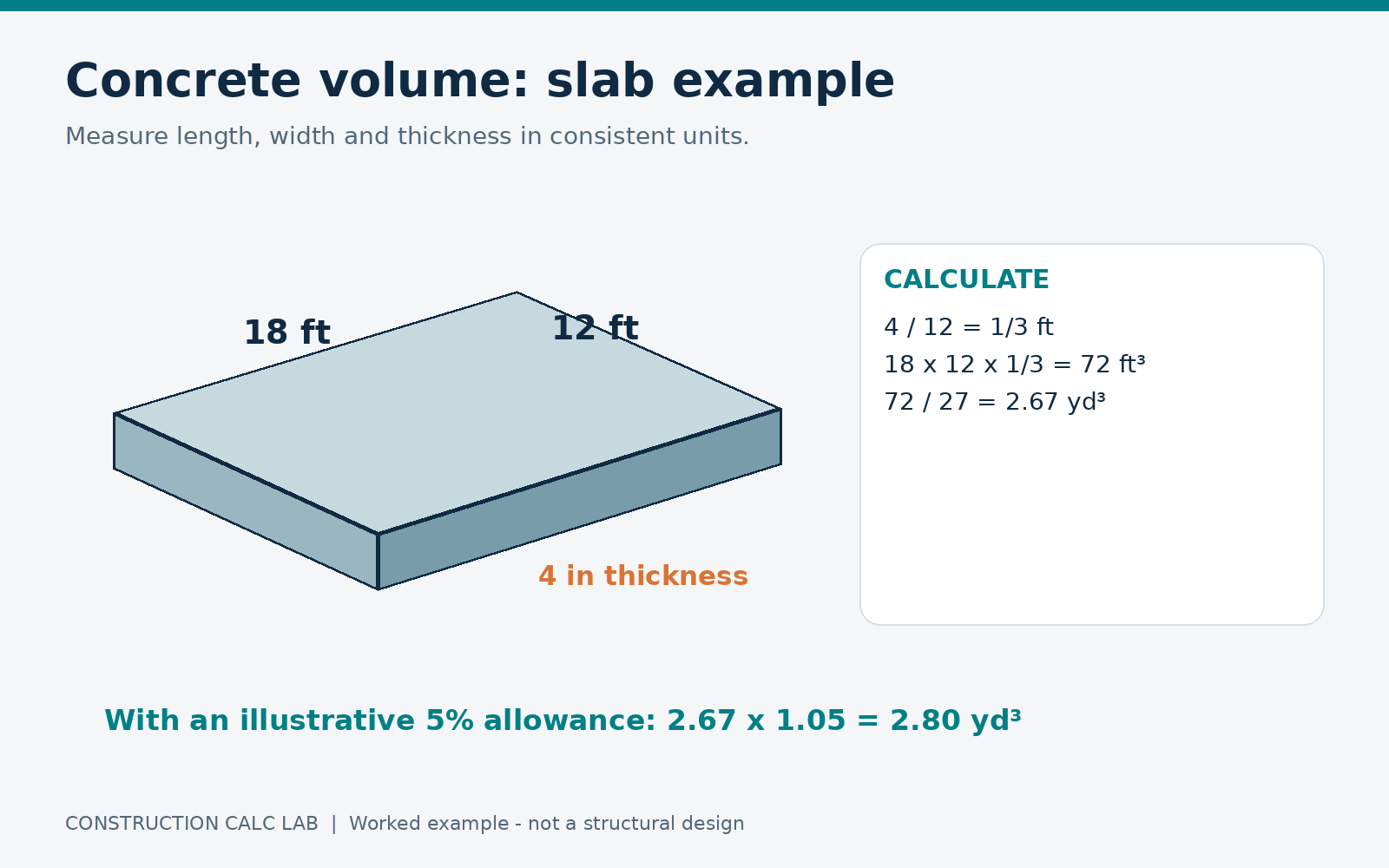
Imagine a 12 ft × 12 ft patio with a uniform 4 in concrete thickness over a prepared base. Its area is 144 square feet and the thickness is 4 ÷ 12 = 0.3333 ft. Volume is 144 × 0.3333 = 48 cubic feet, or 48 ÷ 27 = 1.78 cubic yards. Using the published example yields, 48 ÷ 0.60 = 80 bags at 80 lb, while 48 ÷ 0.45 = 106.67, rounded up to 107 bags at 60 lb.
Suppose you allow 7% for small differences in grade and handling. Purchase volume becomes 48 × 1.07 = 51.36 cubic feet. That means 51.36 ÷ 0.60 = 85.6, rounded to 86 bags at 80 lb, or 51.36 ÷ 0.45 = 114.13, rounded to 115 bags at 60 lb. The same adjusted volume is 51.36 ÷ 27 = 1.90 cubic yards. For ready-mix, ask the supplier about minimum order, rounding increments, delivery access and short-load charges instead of assuming that the exact theoretical volume can be delivered.
Choosing a realistic allowance
A waste allowance is a planning buffer, not a substitute for measuring. A well-formed pad on a compacted, level base may need less spare material than a rough excavation with irregular edges. Start with your calculated volume, inspect the formwork, then choose a justified allowance based on the actual site. Five to ten percent is a useful estimating range for many small jobs, but the right number depends on the base and the method of placement.
Apply the allowance to volume before dividing by the bag yield. If you round each intermediate measurement too early, errors compound. Keep two or three decimal places in the calculation and round up only at the final bag count. If you already included a measured thickened edge or a separate footing in the volume, do not add it again as “waste.”
Thickened edges, footings and steps need separate takeoffs
Many slabs have a perimeter edge deeper than the middle. Calculate the uniform field volume first. Then calculate only the extra concrete below the normal slab depth around the perimeter. For a simple rectangular edge, use edge length × edge width × additional depth. Deduct overlap at corners, or divide the edge into four non-overlapping sections. Add the edge volume to the field volume before converting to bags.
For instance, a nominal 4 in slab with an 8 in deep edge does not have an 8 in extra edge: it has 4 in extra below the 4 in already counted. A 20 ft edge that is 1 ft wide adds 20 × 1 × 4 ÷ 12 = 6.67 cubic feet, before corner adjustments. That alone is about 12 more 80 lb bags. A post hole, pier or strip footing also needs its own shape calculation. Our footing calculator guide explains the separate geometry.
When bags make sense and when ready-mix may be better
Bagged mix is practical for a small pad when you can transport, store and mix the material at a steady pace. It can also help when a delivery truck cannot reach the site. Ready-mix becomes worth pricing as the volume and bag count rise. Compare the total delivered cost, including minimum-load fees, with bags, transport, mixer rental, labor and disposal. There is no universal price cutoff because suppliers, locations and access differ.
Work time matters as much as material price. A larger slab should be placed and finished in a coordinated sequence while the concrete remains workable. Mixing dozens of bags by hand can make it difficult to maintain a continuous pour. Plan enough people and equipment for placement and finishing, follow the product’s mixing instructions, and do not add extra water to chase workability. For structural or vehicle-bearing work, confirm the specified mix and reinforcement with the project design and local requirements.
Common bag-count mistakes to avoid
- Using square feet as volume: the plan area must be multiplied by thickness.
- Leaving thickness in inches: divide inches by 12 before multiplying feet.
- Using bag weight instead of yield: a 60 lb bag does not fill 60 cubic feet; use the label’s mixed yield.
- Ignoring the actual forms: a wider or deeper excavation changes the quantity.
- Counting a thickened edge twice: calculate only the extra depth after the uniform slab.
- Buying exactly the theoretical count: plan for reasonable site variation.
- Assuming all products have the same yield: verify the brand and product.
Our concrete slab estimate checklist provides another way to review dimensions, edge geometry and ordering notes before purchase. The concrete volume guide covers related shapes and conversions.
A simple worksheet before you order
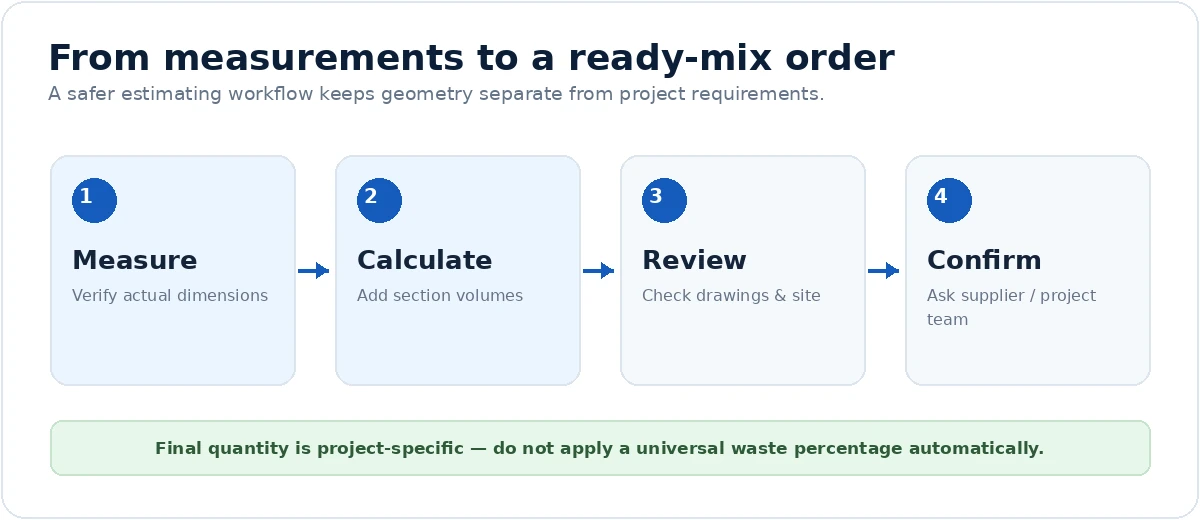
Write down the measured inside length and width of each zone, the concrete depth after the base is compacted, the extra volume for edges or separate features, and the selected product’s stated yield. Multiply to find total cubic feet, add a justified allowance, divide by yield, and round up. Keep the calculations with your receipt so you can explain a changed quantity if the forms move or the design changes.
If choosing ready-mix, convert the same adjusted cubic feet to cubic yards by dividing by 27. Give the supplier the project location, access details, proposed mix specification, required delivery time and target volume. Ask how the plant handles small orders and whether your chosen quantity is within its delivery increment. Use our concrete calculator to cross-check the dimension conversion, then check the final result against your written measurements.
Frequently asked questions about concrete bags for a slab
How many 80 lb concrete bags for a 10 × 10 slab at 4 inches?
At a 0.60 cubic foot yield, the exact slab volume is 33.33 cubic feet and the theoretical count is 56 bags after rounding up. A 10% volume allowance raises that to 62 bags. If the base or thickness differs, recalculate from the actual measurements.
How many 60 lb concrete bags for the same slab?
At 0.45 cubic feet per bag, divide 33.33 by 0.45 and round up to 75 bags. With a 10% volume allowance, the count is 82 bags. Check the package because yields vary among products.
How many bags are in one cubic yard of concrete?
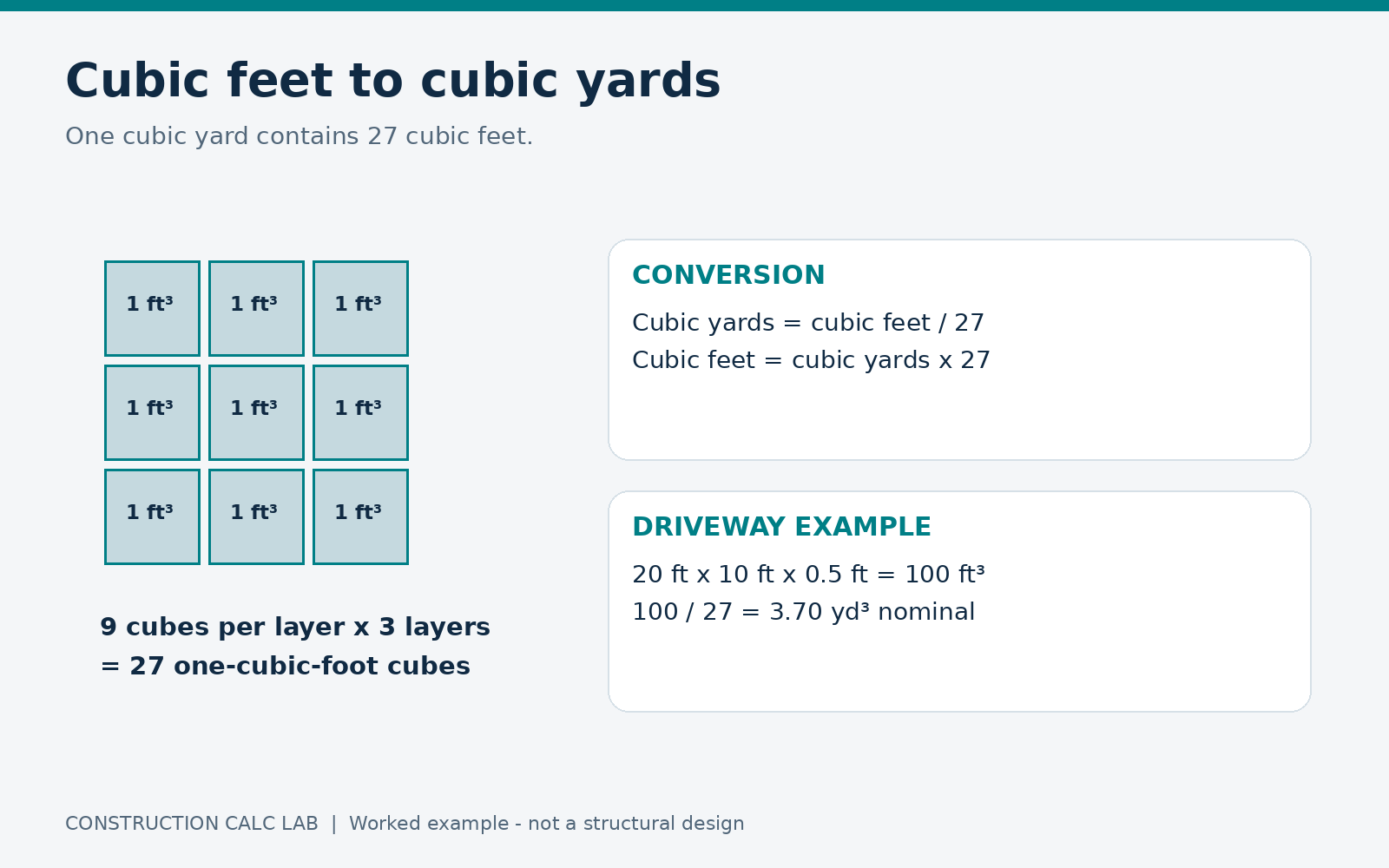
One cubic yard is 27 cubic feet. At 0.60 cubic feet per 80 lb bag, 27 ÷ 0.60 = 45 bags. At 0.45 cubic feet per 60 lb bag, 27 ÷ 0.45 = 60 bags. Those are theoretical yields before handling loss or irregular forms. See our cubic feet to cubic yards conversion guide for the unit relationship.
Should I include the gravel base in the concrete quantity?
No. Measure the concrete layer after the prepared base is in place. Estimate and purchase compacted gravel separately. If you have a thickened edge, count the additional concrete depth in that edge as a separate volume.
Can a bag estimate replace a structural slab specification?
No. A bag calculation estimates quantity only. It does not establish mix strength, reinforcement, base design, curing method or required slab thickness. Follow the project documents, manufacturer directions and local requirements for those decisions.
Final check: concrete bags for a slab equal adjusted cubic-foot volume divided by the chosen bag’s actual yield, rounded up. Verify dimensions after the forms and base are ready. For a large count, get a ready-mix quote and compare the full job cost and placement plan before purchasing.